Archive for ‘Travel Writing’

January 10, 2012

New Orleans is Rising

[Heading back to the Big Easy in a couple of days and thought I’d publish this story that first appeared last February in the Toronto Star.]

dwayne dopsie new orleans

Accordionist Dwayne Dopsie plays rock classics at Krazy Korner down on Bourbon Street. (Julia Pelish photo)


NEW ORLEANS, LOUISIANA — Krista Schuster sits at a bar in Pirate’s Alley, her fiancé beside her, a well drink in her hand, the thump of a tuba in her ear and beignets on her mind.

“The best travel deal going is New Orleans,” she declares.

In December, Schuster, a Pittsburgh resident who has worked as a travel agent, made her fourth visit to the Big Easy since 2006. New Orleans has taken its punches, as everyone knows, but you can’t beat the spirit of this place, or its citizens. Mardi Gras starts March 8 here, but this is a rollicking city any time of year.

“People are so much fun, it’s cheap and the food and music are amazing,” she says.

The food and the music.

They are the hallmarks of this town, what keep people coming and what makes you entice others to visit once you’ve returned home.

Bourbon Street is a blast, but it’s not where you should spend most of your time. It’s a spot for tourists and college kids looking for debauchery. There are things to enjoy, for sure. Great music can be found in a number of places on the street and those looking to splurge should drop in on Arnaud’s for a meal. The historic restaurant, which has a small Mardi Gras museum on its second floor, is an icon of the food scene and deserves the laurels it has received through the years.

read more »

January 2, 2012

Skating at the edge of Niagara Falls

rink-on-the-brink

The Rink at the Brink is a thrill in Niagara Falls. (Julia Pelish photo)

NIAGARA FALLS, ONTARIO — Skating outdoors is nothing new for Canadians. Doing it a couple of hundred metres from certain death? That gives a new meaning to going over the boards.

The unique thrill of skating adjacent to Niagara Falls is the overwhelming appeal of the TD Rink at the Brink, which opened its third season on November 30. Expectations are it will host more visitors than it did last year, when 15,000 skaters revelled in the rink set up on Niagara Parkway, about 200 metres across from the natural wonder. Despite the hyperbolic name, there’s no chance of a wayward skater plunging over the Horseshoe Falls. The only threat to a good time, really, is the on-site concession stand running out of hot chocolate.

“There’s nothing like this anywhere else in the world,” said David Groulx, operations manager at the Rink at the Brink and a former owner of the Florida-based Sunshine Coast Hockey League. “You can’t skate this close to an attraction like the Falls anywhere. It’s a really unique experience”

Groulx maintains the ice conditions, which were very good when I went for a few spins on Saturday. It was a magical evening, actually, with the lunar eclipse that night causing a bright, orange-yellow moon to climb slowly over the Niagara night. At first glance, the Rink at the Brink seems like a victim of its own good marketing. When you walk up to it, you feel a touch of disappointment because it is not right at the edge of the Falls, but once you start to skate, the sight of the water curtaining over the cliff and the beauty of the mist rising up and then freezing as it clings to tree branches really is a thrill. I found myself stopping several times or turning my head around just to look.

“Every day is different here. This afternoon, we had a rainbow that came over the Falls and ended right here on the rink,” says Groulx. “There are days when the mist rises over the moraine here and crystallizes, and it’s just absolutely gorgeous.”

The rink, which is 60 feet-by-120 feet, will stay open until February 29. It costs $7 for adults and $6 for youths to skate, which might be a deterrent considering Canadians across the country are used to skating for free on outdoor rinks, including at Nathan Phillips Square in Toronto and the Rideau Canal in Ottawa. The Rink at the Brink, though, is a distinct experience and one that’s certainly worth at least one outing.

“This is really beautiful, to see the Falls like that and with all the lights in the city. They did a great job with it,” said Kelly Dawns, who is from Toronto. She credited the rink for keeping her kids busy and blending in with the rest of the festive atmosphere in Niagara.

read more »

November 11, 2011

Frank Dodd, Jason Parsons are good friends running separate wineries

[Story first appeared on Vacay.ca]

NIAGARA-ON-THE-LAKE, ONTARIO—Survive war and you’ll have friends for life. For chefs Frank Dodd and Jason Parsons, the field of battle was Cliveden House, a 160-year-old manor built along the Thames in a suburb of London. With a turreted roof and massive opulence, it looks like the kind of place a tyrant would call home and, according to the chefs who’ve apprenticed there, one has.

frank dodd hillebrand winery

Frank Dodd is the chef at the outstanding Hillebrand Winery, close to his friend's restaurant at Peller. (Julia Pelish photo)

Dodd spent six months training in the British armed services and says the best thing about that experience is it prepped him for Cliveden. Parsons calls the 12 months he spent at Cliveden between 1995-96 the toughest of his 37 years of life. His wife, Meg, says the man who used to run this particular hell’s kitchen “makes Gordon Ramsay look like a pansy.”

His name is Ron Maxfield. During his time in the Cliveden kitchen, he churned out a good amount of chefs and at least one pair of brothers in arms.

read more »

November 3, 2011

This woman gave it all up to travel — would you?

SANTIAGO, GALAPAGOS ISLANDS, ECUADOR — Barbara Weibel says she’s no inspiration. If you’ve ever been tempted to spend your entire life seeing the world, you might disagree.

Barbara Weibel of Holeinthedonut

Barbara Weibel runs the popular travel blog Holeinthedonut.com.

Weibel left her career in commercial real estate five years ago to explore Earth and she has no intention of stopping. With no fixed address, next to no personal belongings other than what she can fit in her backpack, no debt and no ambitions to return to the corporate world despite being down to $17,000 in her savings account, Weibel leads a nomadic life that has won her a sizeable audience for her blog, HoleintheDonut.com.

Illness made the Floridian, by way of Illinois, commit to a dramatic change in her lifestyle. Weibel suffered from the most severe form of lyme disease, which is potentially fatal and kept her bed-ridden for weeks. “During my time in the hospital, I really had time to think about what I really wanted to do with my life. And I remembered when I was a teenager, I wanted to be a journalist, I wanted to be a war correspondent and travel to far-off places. But my father always told me that I needed a job and I needed to save for retirement and so that’s what I did,” said Weibel, who is 59.

MORE FROM THE GALAPAGOS: HUMANS BRING DANGER

She said she has started to bring in enough revenue from advertising on her blog and through freelance sales of her articles and photographs that she can continue pursuing her passion of seeing the world for the foreseeable future. Weibel’s focus is on telling stories of the different cultures she encounters, which are often far, far from the tourist path.

“So many of us wouldn’t do this because we worry about what our families would think of us, what our friends would think of us, what society would think of us,” said Weibel, “but when I was sick, I had to decide what was most important for me, what made me happy and what did I really want to do with my life. And this was it.”

In 2006, she loaded her backpack and left for Vietnam. “I thought it would be cathartic for me, because I am of the generation that went through the war.” She awoke to how another culture can have a distinct perspective on events. “The fact that they call it the American War, not the Vietnam War, that was eyeopening for me.”

read more »

October 26, 2011

The Great Dessert Search, Edition No. 4: Le Bremner Jelly Doughnuts

Jelly Doughnuts - Le Bremner Montreal

At Le Bremner, the Jelly Doughnuts come in chocolate, lemon and fruity jam flavours. (Julia Pelish photo)

MONTREAL — Soft, sugary, sweet and so guilt-inducing they’ll sentence you to the gym for a week, at least. The Jelly Doughnuts at the most talked about new restaurant in Montreal, if not Canada, are deliriously tasty, as well as a reminder that Le Bremner is a fun, casual place, no matter all the buzz about it and its celeb chef.

The doughnuts come three to a plate, each filled with a different creamy, gooey centre. These are Timbits on steroids — and after a serious retool in a masterful kitchen. Whether it’s the chocolate, lemon or fruity jam flavour, the Le Bremner doughnuts satisfy your craving for sweets and do it in a way that’ll make you smile — which is what a great dessert should do. It’s a playful dish, as well as a delicious one.

read more »

October 25, 2011

New addition makes this Montreal museum the best in Canada

montreal-museum-of-fine-arts

A view of the Paviliion of Quebec and Canadian Art seen from inside the Jean-Noël Desmarais Pavilion across the street. ©Julia Pelish Photography

[First published on Vacay.ca, a new site dedicated to Canadian travel experiences.]

MONTREAL — Even before its newest wing, the Montreal Museum of Fine Arts offered visitors an excellent review of Canadian and international painting. What the two-week-old Claire and Marc Bourgie Pavilion of Quebec and Canadian Art accomplishes, however, is so tremendous it hoists this attraction to the top, making it the best museum in Canada. Hands-down.

read more »

October 19, 2011

On Galapagos Islands, humans bring wealth and danger

santa cruz galapagos islands

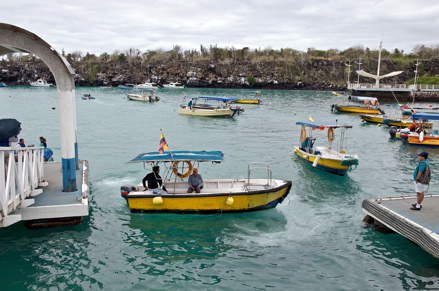
Boat activity is bustling on the shores of Santa Cruz, the most populous of the Galapagos Islands. (Julia Pelish photo)

PUERTO AYORA, SANTA CRUZ, GALAPAGOS ISLANDS, ECUADOR — Yvonne Mórtola walks down Avendida Charles Darwin with a frown. One white Toyota pick-up truck after another passes down this two-lane asphalt road in the most populous city of the Galapagos Islands. Engine revs and muffler coughs have suffocated the sounds of nature that so signify these protected islands off the Ecuadorean coast. No longer is it easy for Santa Cruz residents like Mórtola to stand on a street corner of Avendida Charles Darwin and hear waves lapping, finches’ chirps or sea lion barks.

“This used to be a dirt road,” says Mórtola, a top-level Ecuador National Parks Service naturalist who works as a guide for tour operator Ecoventura. “I used to be able to throw a Frisbee to my dog down here, but I can’t do that anymore. It just isn’t safe on the road.”

While 97 percent of the islands are protected by the parks, it’s what’s happened to the other 3 percent that worries Mórtola and others concerned about the environment on the Galapagos. In the 1990s, migrants arrived looking to get in on one of the world’s oddest commodity booms. Call it the Great Sea Cucumber Rush. The marine animal that helps clean oceans of bacteria, algae and waste is highly coveted by the Chinese and Japanese as a delicacy and an aphrodisiac. With an abundance of sea cucumbers, the Galapagos became a focal point for the trade. Fishermen could get $1 per sea cucumber and reports said that 10,000 sea cucumbers would be shipped daily from the Galapagos. Those fishermen could sometimes catch in an hour enough sea cucumbers with an equivalent value of a week’s worth of traditional fishing.

Mórtola, who has lived on the islands for more than a quarter-century, says she remembers prostitutes on Santa Cruz earning so much money during the height of the boom that “they would light their cigarettes with $10 bills.”

The population of Santa Cruz rose nearly four-fold, reaching 10,000 before the government passed a unique policy called the Galapagos Resident Law, which states that no one can live on the islands unless they were born there, married someone who resides there or could prove they worked there prior to 1998, the year the law was enacted. Still, the population of Santa Cruz has continued to grow, reaching 16,500 as of the last census and Puerto Ayora is at 12,000 people. In recent years, the government has been expelling thousands of illegal, undocumented migrants from the island.

“You look at Santa Cruz, and it used to be a very nice community,” says Pablo Jaramillo, the captain of Eric, Ecoventura’s recently renovated yacht, and a resident of San Cristobal, the second most populous island (8,000). “But there are too many people now. You do not even know your neighbour in some cases.”

READ ‘GALAPAGOS TRAVEL TIPS: WHAT TO EXPECT WHEN YOU GO’

More lush than the other 12 main islands in the chain, Santa Cruz is home to the Darwin Research Station, where the giant tortoise population is being rehabilitated in a huge undertaking that involves such careful incubation of eggs that researchers can create the sex they want by manipulating the temperature. When the incubator is set to 29.5 Celsius degrees, females will be born. At 28 Celsius, a male will hatch. With the species needing to grow, more females are being created at the station.

read more »

October 14, 2011

Galapagos Island travel tip: Don’t expect a vacation

Blue-footed-boobies-galapagos-islands

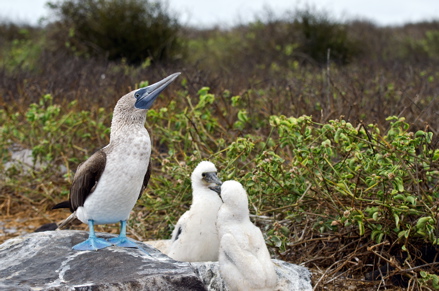
Blue-footed boobies and their adorable chicks are among the wildlife that can only be seen on the Galapagos Islands. (Julia Pelish photo)

SAN CRISTOBAL, GALAPAGOS ISLANDS, ECUADOR — They come. Nikon-necked boobies, Timberland-sandaled grey-bearded enviro cats, North Face-clothed soft-core adventure seekers. They come by the planeload, arriving in greater numbers than ever. And more and more of them come without knowing exactly what they’re in for.

A trip to the Galapagos Islands turned out to be as fascinating and rewarding and fun an adventure as I have ever had. But it was no vacation.

You’re here to learn and the teachers are naturalists fiercely devoted to the islands and the ideal that the word “Galapagos” has come to signify during the past century and a half. You will not be comfortable: the boat will rock, sometimes with enough force to cause your stomach to somersault; the 44-pound luggage limit will mean choosing between packing more pants or more socks and underwear (go with the latter); hikes will sometimes force you over terrain rocky enough to wreck ankles. You will be requested to do feats that will make you frown, if not cringe and swear under your breath: Navy showers (lather up, soak in lukewarm water, shut off the tap, repeat) are supposed to be taken onboard to limit the amount of water used; toilet paper isn’t to be flushed, it’s to be placed in a waste-paper basket for disposal by the housekeeper; wake-up calls can come as early as 5:45 a.m.; depending on the loudness of the motor and the temperament of the waves, sleep may not come at all.

Yet, when the trip is done, you just might walk away thinking you’ve had an experience that tops all others before it. But you have to be curious and you have to know you won’t be lounging on a beach with mojito in hand and a tiki bar within reach. Food isn’t allowed on shore excursions and neither are alcoholic beverages, although there is an ample supply onboard your boat. While the islands are filled with animals that won’t so much as flutter as you approach, the Galapagos isn’t a petting zoo and touching is off-limits.

So, where’s all the fun? Part of it is in the discovery of the place and in the camaraderie you build with the group you discover it with. Part of it is in the enchantment you acquire for the wildlife, whose personalities make you remember childhood and the anthropomorphic qualities we attributed to them. Much of it is simply in the indulgence of being here. The isolation is stark. On many instances, I caught myself listening to the wind, often a bluster that seemed to exist to remind us we were still on earth. The sunsets are special, with the big yellow ball escaping below the wide-open horizon with no land westward until you hit the Hawaiian islands — 7,600 kilometres away. And there’s the real reason why someone should make this trip: The opportunity to be educated.

READ ABOUT ‘THE GALAPAGOS OF THE NORTH’

You’ll learn about our planet and the animals and plants and birds and reptiles that occupy it. You’ll brush up on your Darwin and hook into the environmental importance of the 13 main islands. You’ll learn about the threat humans pose to the ecosystem and the harm we have already inflicted. To some degree or another, coverage of those topics is to be expected. The surprise, though, is the passion with which the naturalists distill the information.

read more »